Difference Between Reading and Listening to Jfk Inaugural Address
ii.3 Reading a Text Carefully and Closely
Learning Objectives
- Demonstrate how to do a close reading on a choice from the Notation 2.v "Gallery of Web-Based Texts".
- Uncover the assumptions and implications of textual statements and empathise how biases and preconceptions affect readers and writers.
- Show how a close reading of any statement is based on uncovering its assumptions, biases, preconceptions, and implications.
In this section, we'll apply an excerpt from i of the about famous inaugural addresses in American history, from John F. Kennedy in 1961, to demonstrate how to do a close reading past separating fact and opinion; uncovering assumptionsA conventionalities that underlies a writer's suggestion or argument. , biasesA deeply held and ingrained belief that tin can deject ane's perspective as a writer or reader. , and preconceptionsAn thought already held by a writer or reader in advance of making or receiving a textual argument. ; and pursuing the implicationsWhat readers can infer from statements a writer makes. of textual statements. (The address is available in its entirety through the Annotation 2.5 "Gallery of Web-Based Texts" in Section 2.i "Browsing the Gallery of Spider web-Based Texts", in text class at the Avalon Project, and in video grade at the C-SPAN Video Library.)
To prepare yourself to develop a thoughtful, critical reading of a text like this, you might brainstorm with the 20 Questions about Cocky, Text, and Context from Chapter i "Writing to Think and Writing to Learn", filling in each bare with "Kennedy's Inaugural Address."
Twenty Questions about Self, Text, and Context
Cocky-Text Questions
- What practise I remember about Kennedy's Inaugural Accost?
- What practise I feel about Kennedy's Inaugural Accost?
- What exercise I sympathize or what puzzles me in or about Kennedy'southward Inaugural Address?
- What turns me off or amuses me in or about Kennedy's Inaugural Address?
- What is anticipated or surprises me in or about Kennedy'southward Countdown Address?
Text-Context Questions
- How is Kennedy's Inaugural Address a product of its civilization and historical moment?
- What might be of import to know about the creator of Kennedy's Inaugural Address?
- How is Kennedy'south Countdown Address affected past the genre and medium to which it belongs?
- What other texts in its genre and medium does Kennedy's Inaugural Address resemble?
- How does Kennedy's Inaugural Address distinguish itself from other texts in its genre and medium?
Self-Context Questions
- How have I adult my aesthetic sensibility (my tastes, my likes, and my dislikes)?
- How do I typically respond to absolutes or ambiguities in life or in art? Do I respond favorably to gray areas or do I similar things more clear-cut?
- With what groups (ethnic, racial, religious, social, gendered, economical, nationalist, regional, etc.) practise I place?
- How have my social, political, and ethical opinions been formed?
- How do my attitudes toward the "great questions" (option vs. necessity, nature vs. nurture, tradition vs. change, etc.) affect the way I await at the world?
Self-Text-Context Questions
- How does my personal, cultural, and social groundwork affect my agreement of Kennedy's Inaugural Address?
- What else might I demand to learn about the culture, the historical moment, or the creator that produced Kennedy's Countdown Accost in order to more fully understand information technology?
- What else about the genre or medium of Kennedy'southward Inaugural Address might I need to larn in order to sympathize information technology better?
- How might Kennedy'south Inaugural Address look or sound different if information technology were produced in a different time or place?
- How might Kennedy's Inaugural Address look or sound unlike if I were viewing information technology from a different perspective or identification?
Annotation that most of these questions can't be answered until you've made a first pass through the text, while others almost certainly crave some enquiry to be answered fully. It's almost a given that multiple readings will be required to fully sympathise a text, its context, and your orientation toward it.
In the first note, let's consider Roger (Educatee A) and Rhonda (Student B), both of whom read the speech without any advance preparation and without examining their biases and preconceptions. Take a look at the comment boxes fastened to the excerpt of the first v paragraphs of Kennedy's Countdown Address.
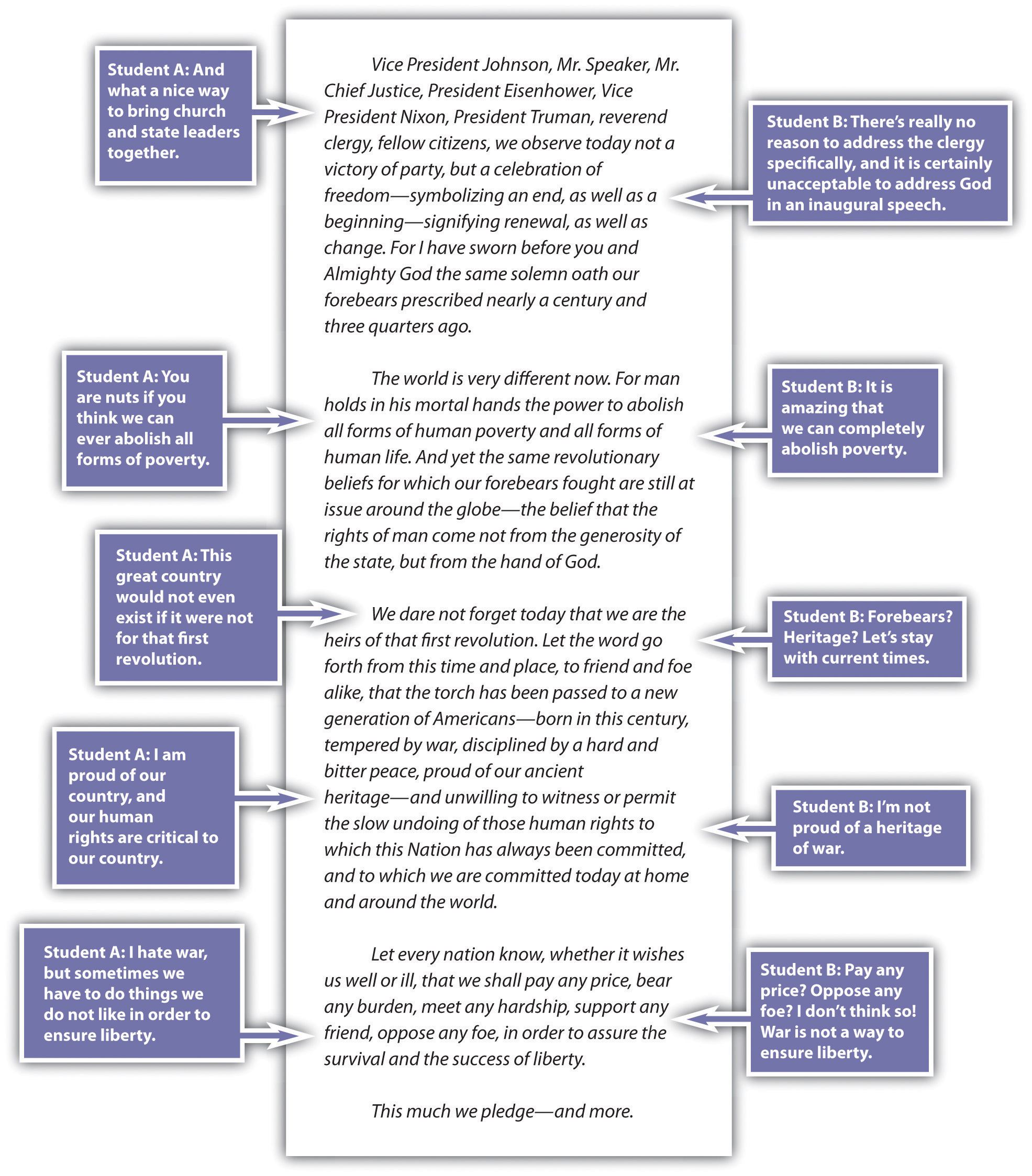
Roger does non have whatever trouble with a lack of separation between church and state. Rhonda is unwilling to accept whatsoever reference to God in any government setting. Should Roger at to the lowest degree recognize the rationale for separating church building and state? Should Rhonda recognize that while the founders of this land called for such a separation, they as well made repeated reference to God in their writings?
Mayhap both Roger and Rhonda should consider that Kennedy's lofty goal of eliminating poverty was possibly an intentional rhetorical overreach, typical of inaugural addresses, meant to inspire the full general process of poverty elimination and not to lay out specific policy.
Roger sees war every bit a necessary evil in the search for peace. Rhonda sees state of war as an unacceptable evil that should never exist used as a means to an terminate. To hear what Kennedy is saying, Roger probably needs to consider options other than war and Rhonda probably needs to recognize that history has shown some positive results from "necessary" wars.
If Roger and Rhonda want to be critical thinkers or even if they want have a meaningful conversation about the text, they must think through and by their own personal biases and preconceptions. They must fix themselves to be critical readers.
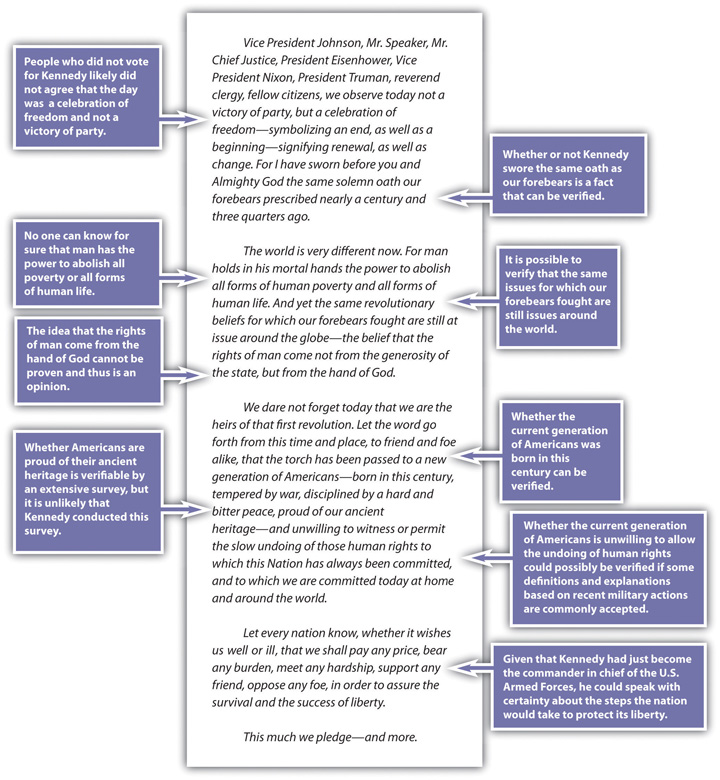
In the adjacent set of annotations, let's look at what you could exercise with the text by making several close readings of it, while also subjecting it to the preceding Twenty Questions. Perhaps your first annotation could simply exist designed to separate statements of verifiable fact from those of subjective opinion.
A careful reader who looks for assumptions and implications of statements will discover enough of them. For example, the beginning of Kennedy's Inaugural Accost includes many assumptions. In your 2nd notation, you lot might get on to target some of these assumptions and offer groundwork thoughts that help you place and understand these assumptions.
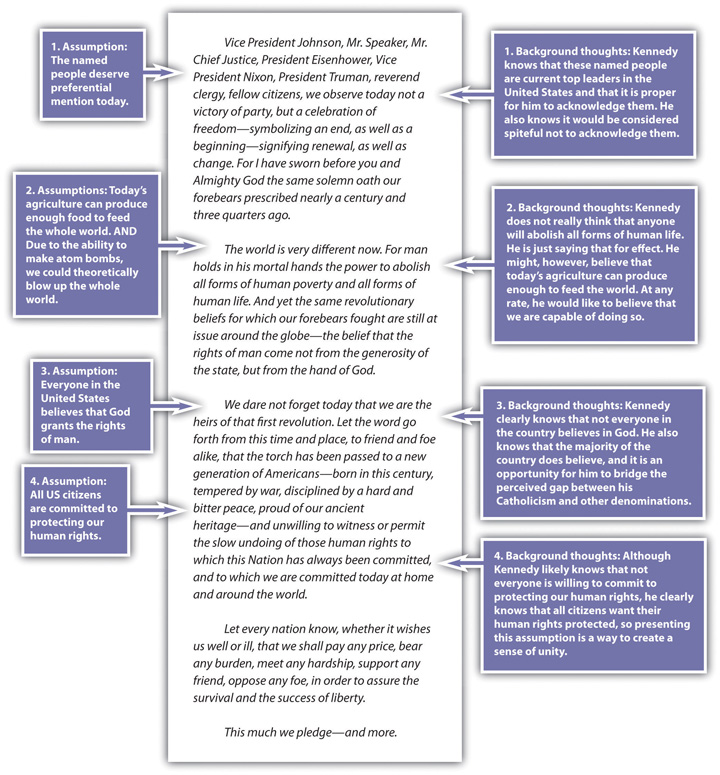
Just as you must attempt to trace a argument back to its underlying assumptions, y'all must likewise effort to sympathize what a statement implies. Fifty-fifty when different readers are looking at the same text, they can sometimes disagree nearly the implications of a argument. Their disagreements oft course the basis for their divergent opinions as readers.
Accept Kennedy'south assumption that the named people at the beginning of his speech deserve preferential attention. Here are some possible implications of the statement y'all could come upwardly with that result from that unmarried assumption:
- People who voted for Nixon are reminded that their candidate did not get elected, which makes these people aroused all over again.
- People who voted for Nixon feel somewhat comforted knowing that Nixon and Eisenhower are being recognized at the inauguration, and they are pleased that Kennedy is acknowledging them.
- Supporters of Kennedy hear his recognition of Nixon and Eisenhower as an acceptance of them, and thus they await more favorably on members of the opposing political party.
- Supporters of Johnson capeesh that Kennedy mentions him start and believe that he is giving the most respect of all to Johnson.
- Those concerned about the relative youth of this new president capeesh the deference he shows to tradition by making this rhetorical gesture of salutation.
- Those suspicious of the power of the executive branch might wonder why Kennedy addresses the sometime presidents and vice president by name just gives only the title of the Supreme Court primary justice and the Speaker of the House.
You lot could add more to this list of possible implications, but detect how much you've washed with the first paragraph of the voice communication already, simply by slowing down your disquisitional reading process.
Fundamental Takeaways
- Virtually any argument carries a set of assumptions (what the writer or speaker assumes in order to make the statement) and implications (what the argument implies to readers or listeners).
- You need to be able to recognize biases and preconceptions in others and in yourself so you can form your ideas and nowadays them responsibly.
Exercises
- Utilize some of the disquisitional thinking methods outlined in this department to some other presidential inaugural address. For a complete drove, cheque out the Avalon Projection in the Note two.5 "Gallery of Web-Based Texts" at the beginning of the affiliate. Click on "Inaugural Addresses of the Presidents" in the main directory. Videos of all inaugural addresses since Truman's in 1948 tin can be establish at the C-Span Video Library.
- Presidential inaugural addresses, having developed over more than two centuries, follow a certain set of unspoken rules of a highly traditional genre. Later looking at 3 to five other examples of the genre also Kennedy's, list at to the lowest degree five things near inaugural addresses are expected to achieve. Give examples and excerpts of those generic conventions from the three to v other texts y'all choose. Or effort this exercise with other regularly scheduled, ceremonial addresses like the State of the Union.
- Watch at least one hour apiece of prime-time cable news on the Play a trick on News Channel and MSNBC (preferably the same hour or at to the lowest degree the same night of coverage). Catalogue the biases, preconceptions, assumptions, and implications of the news coverage and commentary on the aforementioned topic during those two hours. If invitee "experts" are interviewed, discuss their political ideologies as well.
Source: https://saylordotorg.github.io/text_handbook-for-writers/s06-03-reading-a-text-carefully-and-c.html
0 Response to "Difference Between Reading and Listening to Jfk Inaugural Address"
Post a Comment