Keep Calm and Turn on and Off Again
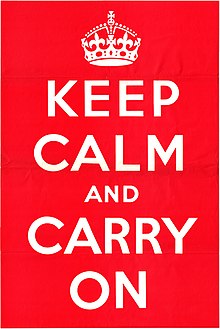
Keep At-home and Carry On was a motivational affiche produced by the British government in 1939 in preparation for World State of war II. The poster was intended to raise the morale of the British public, threatened with widely predicted mass air attacks on major cities.[1] [2] Although two.45 million copies were printed, and the Blitz did in fact take place, the poster was only rarely publicly displayed and was fiddling known until a copy was rediscovered in 2000 at Barter Books, a bookshop in Alnwick.[3] It has since been re-issued by a number of private companies, and has been used equally the decorative theme for a range of products.[four]
Evocative of the Victorian belief in British stoicism – the "stiff upper lip", self-subject, fortitude, and remaining calm in adversity – the poster has become recognised around the world.[5] Information technology was thought that only ii original copies survived until a drove of approximately xv was brought in to the Antiques Roadshow in 2012 by the daughter of an ex-Regal Observer Corps member.[ citation needed ] A few further examples take come up to light since.[6]
History [edit]
Blueprint [edit]
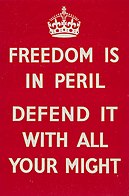
"Freedom Is in Peril" (reconstruction)
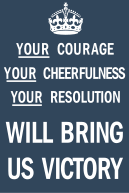
"Your Courage" (reconstruction)
During 1938 newspapers were sold with a poster "Keep Calm and Dig".[7]
The Keep Calm and Bear On poster was designed by the Ministry of Data during the period of 27 June to 6 July 1939.[8] It was produced as one of three "Home Publicity" posters (the others read "Your Courage, Your Cheerfulness, Your Resolution Volition Bring U.s.a. Victory" and "Freedom Is in Peril / Defend It With All Your Might"). Each poster showed the slogan under a representation of a "Tudor Crown" (a symbol of the state). Keep Calm was intended to be distributed to strengthen morale in the event of a wartime disaster, such as mass bombing of major cities using loftier explosives and toxicant gas, which was widely expected within hours of an outbreak of war.[2]
A career civil retainer named A. P. Waterfield came up with "Your Courage" every bit ane of several suggestions to be used as "a rallying war-cry that volition bring out the all-time in anybody of us and put us in an offensive mood at once".[2] [ix] Others involved in the planning of the early posters included: John Hilton, Professor of Industrial Relations at Cambridge University, responsible overall as Director of Home Publicity; William Surrey Dane, managing managing director at Odhams Press; Gervas Huxley, former head of publicity for the Empire Marketing Lath; William Codling, controller of HMSO; Harold Nicolson, MP; West. G. V. Vaughan, who became Director of the Full general Production Division (GPD); H. Five. Rhodes, who later wrote an occasional paper on setting upwards a new government department; Ivison Macadam; "Mr Cruthley"; and "Mr Francis". Ernest Wallcousins was the artist tasked with creating the poster designs.[10]
Detailed planning for the posters had started in April 1939 and the eventual designs were prepared after meetings between officials from the Ministry building of Information and HM Treasury on 26 June 1939 and between officials from the Ministry of Information and HMSO on 27 June 1939.[8] Roughs of the affiche were completed on 6 July 1939, and the concluding designs were agreed by the Habitation Secretary Samuel Hoare, 1st Viscount Templewood on iv Baronial 1939. Printing began on 23 August 1939, the day that Nazi Germany and the USSR signed the Molotov–Ribbentrop Pact, and the posters were ready to be placed up within 24 hours of the outbreak of state of war.[8]
The posters were produced in eleven dissimilar sizes, ranging from fifteen × x inches (38 × 25 cm) upwardly to large 48-canvass versions.[11] The background color was either reddish or blue.[12] The lettering was probably hand-drawn by Wallcousins:[13] [xiv] information technology is like, but non identical, to humanist sans-serif typefaces such every bit Gill Sans and Johnston.[15]
Production and distribution [edit]
Almost 2,500,000 copies of Go on Calm and Carry On were printed between 23 August and 3 September 1939 but while Your Courage and Freedom is in peril were both widely distributed, Proceed Calm was not sanctioned for immediate public brandish.[xvi] It was instead decided that copies should remain in "cold storage" for utilise after serious air raids (with resources transferred to Your Courage and Freedom is in Peril). Copies of Proceed At-home and Conduct On were retained until Apr 1940, but stocks were and so pulped every bit function of the wider Paper Relieve campaign.[8] A few copies practise appear to have been displayed, but such instances were rare and unauthorised. An October 1940 edition of the Yorkshire Mail reports the poster hung in a shop in Leeds;[17] a photograph discovered in 2016 shows information technology on the wall of a authorities laboratory in Bedfordshire.[xviii] and a big version displayed in a pub appears in a 1941 photo by Cecil Beaton.[3]
The posters had been conceived on the assumption that enemy attacks of the civilian population would brainstorm every bit before long as war was alleged, and that there would be a bang-up demand for "a copious effect of general reassurance material".[2] In exercise, the initial poster campaign co-incided with the Phoney State of war, and thus to a population as yet completely unaffected by direct come across with the enemy.
The remainder of the affiche campaign was cancelled in October 1939 post-obit criticism of its cost and touch. Mass Observation analysis of the public response to the campaign was overwhelmingly negative. Criticisms of the posters included Your Courage as being likewise long, confusingly worded, and mostly abrasive due to the sheer number of posters. In detail some had interpreted the message of Your Courage to imply that the common people would suffer for the benefit of the upper classes.[19] [20] Design historian Susannah Walker regards the campaign equally "a resounding failure" and reflective of a misjudgement past upper-form ceremonious servants of the mood of the people.[21] Stuart Manley suggests that the negative reaction to the first two posters resulted in Go along At-home being held back, and that this was an error of sentence: "If they had started with this ane, I think it would have been just as pop then equally it is now.[3]
Later developments [edit]
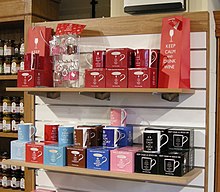
"Keep Calm" merchandise, including the original slogan and variants such as "Continue Calm and Drink Tea", 2013
In tardily May and early on June 1941, 14,000,000 copies of a leaflet entitled "Beating the Invader" were distributed with a message from Prime Minister Winston Churchill. The leaflet begins "If invasion comes..." and exhorts the populace to "Stand Firm" and "Carry On". The two phrases do non appear in ane judgement, equally they practical to different segments of the population depending on their circumstances, with those civilians finding themselves in areas of fighting ordered to stand up firm (i.e., stay put) and those not in areas of fighting ordered to carry on (i.e., continue vital war work). Each mandate is identified every bit a "great order and duty" should invasion come. The leaflet then lists 14 questions and answers on practical measures to be taken.[22]
Rediscovery and commercialisation [edit]

An original poster displayed at Barter Books
In 2000, Stuart Manley, co-possessor with his wife Mary of Barter Books Ltd. in Alnwick, Northumberland, was sorting through a box of 2d-hand books bought at sale when he uncovered one of the original "Keep Calm and Carry On" posters.[iii] The couple framed it and hung information technology upwardly by the cash register; information technology attracted so much interest that Manley began to produce and sell copies.[23] [24] In tardily 2005, Guardian announcer Susie Steiner featured the replica posters as a Christmas gift suggestion, raising their profile however farther.[three] [25] Other companies followed the Manleys' example, and the design rapidly began to be used as the theme for a wide range of products.[26] Mary Manley later commented, "I didn't want it trivialised; but of class now it'due south been trivialised beyond belief."[26]
In early 2012, Barter Books debuted an informational short film, The Story of Continue At-home and Acquit On, providing visual insight into the modernisation and commercialisation of the design and the phrase.[27] As of February 2022 this is no longer bachelor on YouTube.
The poster has get an evocation of British stoicism: the "strong upper lip", self-discipline, fortitude and remaining calm in adversity.[3] Susannah Walker comments that it is now seen "not only as a distillation of a crucial moment in Britishness, but also as an inspiring message from the by to the present in a fourth dimension of crisis".[28] She goes on to point out, withal, that such an interpretation overlooks the circumstances of its production, and the relative failure of the campaign of which it formed a part.[28]
Trademark claims [edit]
| | This section needs to exist updated. (March 2015) |

In August 2011, it was reported that a UK-based visitor called Keep Calm and Bear On Ltd[29] (managed by entrepreneur Marking Coop) had registered the slogan as a community trade marking in the EU, CTM No: 009455619, and in the Us, No. 4066622,[30] [31] after failing to obtain its registration as a trademark in the United Kingdom.[32] [33] The company issued a take-down asking against a seller of Keep At-home and Carry On products.[34] [35] The visitor's right to claim the trademark was questioned past, among others, the Manleys of Castling Books, equally the slogan had been widely used before registration and was not recognisable as indicating merchandise origin.[31] [33]
An application was submitted by British intellectual property counselor and Britain trademarking service Trade Mark Direct to cancel the registration on the grounds that the words were as well widely used for one person to own the exclusive rights,[36] but the asking for cancellation was rejected and the trade marking is however protected in all European union countries.[37] The company subsequently tried to annals the slogan as its trademark in both the United states[38] and Canada.[32] [39]
Imitations [edit]
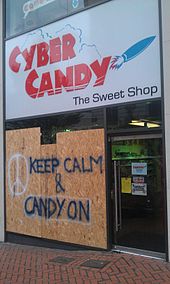
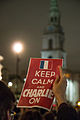
As the popularity of the poster in various media has grown, innumerable parodies, imitations and co-optations have too appeared, making it a notable meme. Messages range from the cute to the overtly political. Examples accept included "Now Panic and Freak Out" (with an upside-down crown), "Get Excited and Make Things" (with a crown incorporating spanners), "Proceed Calm and Have a Cupcake" (with a cupcake icon), "Don't Panic and Simulated a British Accent", "Keep Spending and Conduct On Shopping",[twoscore] "Keep Calm and Don't Sneeze" during the 2009 swine flu pandemic,[41] "Keep Calm and Call Batman" (with the Batman logo),[42] "Keep At-home and Switch to Linux" (with Tux),[43] and "Go on Calm and Wash Your Hands".
In March–April 2012, the British popular-stone ring McFly undertook a theatre tour entitled "The Keep Calm and Play Louder Bout", promoted with a affiche closely based on that of 1939. In tardily 2012 and early 2013, the "Save Lewisham Hospital" entrada (a protest against proposed cuts in services at University Hospital Lewisham) made widespread use of a affiche with the slogan "Don't Go on Calm Go Aroused and Save Lewisham A&East".[44] [45] The efforts of Naheed Nenshi, mayor of Calgary, Alberta, Canada, to encourage and motivate his citizens in the wake of the 2013 Alberta floods made him the subject of parody "Keep Calm and Nenshi On" fundraising T-shirts.[46]
Gallery [edit]
-

Poster parody, 2009
-

T-shirt parody, 2009
-
-

Run into also [edit]
- British propaganda during World War Ii
- Nosotros Can Do It!, an American World War Ii poster which as well became popular decades later
- Live, Laugh, Dearest, another rediscovered phrase that also became popular on decor in the late 2000s.
References [edit]
- ^ Slocombe, Richard (2010). British Posters of the Second Earth State of war. London: Imperial War Museum. p. half-dozen. ISBN9781904897927.
- ^ a b c d Lewis, Rebecca, PhD (five April 2009). "1939: The Iii Posters (PhD Extract)". Keep Calm and Conduct on and other Second World War Posters: British Home Front Propaganda Posters of the Second World War. Archived from the original on two April 2015. Retrieved four February 2013.
- ^ a b c d e f Jack, Malcolm (20 April 2020). "How we made the Go along At-home and Comport On poster". The Guardian . Retrieved 1 Apr 2022.
- ^ Hughes, Stuart (4 Feb 2009). "The Greatest Motivational Poster Ever?". BBC News. Archived from the original on 12 September 2017. Retrieved eighteen March 2009.
- ^ "Keep calm and behave on … bidding for rare poster". The Guardian. ii October 2016. Archived from the original on 4 Nov 2016. Retrieved 2 Nov 2016.
- ^ Lewis 2017, p. 63.
- ^ West Australian, 29 September 1938, page xx. "KEEP Calm AND DIG. Grim London Posters. LONDON, Sept. 27. ...Rain-sodden posters exhort Londoners to "Keep At-home and Dig,"". British Pathe video "Keep At-home and Dig".
- ^ a b c d Irving, Henry (27 June 2014). "Go on Calm and Carry On – The Compromise Backside the Slogan". History of Government Blog. Archived from the original on 10 July 2014. Retrieved 27 June 2014.
- ^ Lewis 2017, pp. 45–6.
- ^ Lewis 2017, pp. 42, 44, 47.
- ^ Lewis 2017, p. 47.
- ^ Lewis 2017, p. 53.
- ^ Kominek, Lex. "Keep Calm and Carry On – WWII Posters". Typophile. Archived from the original on 15 November 2014. Retrieved 28 September 2014.
- ^ Lewis 2017, pp. 44, 47.
- ^ "Keep At-home and Carry On: Fonts". Thousand-Blazon. Archived from the original on fourteen September 2014. Retrieved 28 September 2014. For distinctive features, encounter for example the terminals of the "C".
- ^ Lewis 2017, pp. 49–50.
- ^ "Ban on Silk Stockings: Should They Have Been Rationed?". Yorkshire Mail and Leeds Mercury. 22 October 1940. p. 4. Archived from the original on 4 March 2016. Retrieved 17 Nov 2014.
- ^ Sawer, Patrick; Hooley, Paul (30 October 2016). "Wartime rebels who broke the ban by displaying Keep Calm and Conduct On poster". The Telegraph. Archived from the original on 5 October 2018. Retrieved five October 2018.
- ^ Lewis 2017, pp. 52–57.
- ^ Rees, Nigel (xx July 2011). "Cheer up, the worst is nevertheless to come". Today programme. BBC Radio iv. Archived from the original on 7 October 2020. Retrieved 20 July 2011.
- ^ Walker 2012, pp.6–seven.
- ^ "If Invasion Comes. Mr. Churchill's Orders. "Stand up Firm and Comport On."". The West Australian. Perth, WA, Australia. 26 May 1941. p. 6. Archived from the original on 23 March 2022. Retrieved 25 April 2017.
- ^ "Well-nigh Proceed Calm and Deport On". fourteen Nov 2011. Archived from the original on 16 March 2015. Retrieved 1 May 2013.
- ^ Manley, Stuart (25 April 2009). "First person: 'I am the Keep Calm and Carry On man'". The Independent. Archived from the original on 12 October 2011. Retrieved 20 August 2018.
- ^ Lewis 2017, p. 64.
- ^ a b "Go on Calm and carry on ... into a feud". The Sydney Morn Herald. 4 May 2013. Archived from the original on six May 2013. Retrieved 4 May 2013.
- ^ The Story of Keep Calm and Conduct On on YouTube
- ^ a b Walker 2012, p. 45.
- ^ "Continue Calm and Deport On Ltd". Keepcalmandcarryon.com. Archived from the original on 14 February 2014. Retrieved 24 Feb 2014.
- ^ Bustillos, Maria (5 October 2011). "The Vicious Trademark Battle Over 'Keep Calm and Carry On'". The Awl. Archived from the original on i March 2016.
- ^ a b Phillips, Jeremy (22 Baronial 2011). "Monday miscellany". IPKitten blog. Archived from the original on 8 October 2011. Retrieved xiv September 2011.
- ^ a b Rayner, Gordon (24 September 2011). "Battle rages over 'Proceed Calm and Acquit On' souvenirs". The Daily Telegraph. London. Archived from the original on xiv June 2018. Retrieved iv April 2018.
- ^ a b Lewis 2017, pp. 74–five.
- ^ "Battle over trademark of 'keep calm' phrase". BBC News. 22 September 2010. Archived from the original on 22 September 2011. Retrieved 22 September 2011.
- ^ "Keep at-home and acquit on items removed from my ebay account". justanswer.com. August 2011. Archived from the original on 26 Oct 2012. Retrieved xiv September 2011.
- ^ "IP group aims to repossess 'Go along At-home & Comport On'". freelanceuk.com. Archived from the original on 24 September 2011. Retrieved 21 September 2011.
- ^ Lewis 2017, p. 75.
- ^ "Serial Number: 85297485 Keep At-home and Bear On USA Trademark". Official Gazette. USPTO. 20 September 2011. Archived from the original on four April 2012. Retrieved 7 October 2011.
- ^ "Canadian Trade-marking Data". IC.GC.CA. 13 October 2011. Archived from the original on 12 January 2013. Retrieved 7 October 2011.
- ^ Walker, Rob (five July 2009). "Remixed Letters". The New York Times Mag. Archived from the original on ix Apr 2018. Retrieved 21 March 2012.
- ^ Lewis 2017, p. 66.
- ^ Chris Begley (9 July 2013). "New Batman Easter egg from 'Human of Steel' revealed". batman-news.com. Archived from the original on thirteen June 2017. Retrieved 13 February 2017.
- ^ "Keep calm and switch to Linux". Archived from the original on 12 August 2014. Retrieved 29 June 2014.
- ^ Piffling, Mandy (21 December 2012). "Protestors prove unity". Southward London Press. London. Archived from the original on 28 September 2013. Retrieved 27 Jan 2013.
- ^ "Salvage Lewisham Hospital!". Salve Lewisham Hospital campaign. 2013. Archived from the original on 27 Jan 2013. Retrieved 27 January 2013.
- ^ Dean Bennett (28 June 2013). "Mayor Nenshi has captured Calgary'southward eye, but the worst, at least politically, is even so to come". The Earth and Post. Toronto. Archived from the original on 20 November 2015. Retrieved 24 February 2014.
Further reading [edit]
- Clampin, David (2009). "'To Guide, Aid and Hearten Millions': The Identify of Commercial Advertising in Wartime Britain, 1939–1945". Journal of Macromarketing. 29 (1): 58–73. doi:x.1177/0276146708328054. S2CID 144461596.
- Inkster, Nigel; Nicoll, Alexander (2010). "Proceed Calm and Carry On". Survival: Global Politics and Strategy. 52 (2): 249–256. doi:10.1080/00396331003764777. S2CID 154196367.
- Lewis, Bex (2012). "The Renaissance of 'Keep Calm and Deport On'". The Poster. 2: seven–23. doi:10.1386/post.2.one.7_1.
- Lewis, Bex (2017). Continue At-home and Carry On: The Truth Behind the Poster. London: Royal War Museum. ISBN978-1904897347. OCLC 979568000.
- Walker, Susannah (2012). Dwelling Front Posters of the Second World War. Oxford: Shire. ISBN9780747811428.
External links [edit]
- The Truth Behind Go on Calm and Bear On, Royal War Museum (January 2019)
Source: https://en.wikipedia.org/wiki/Keep_Calm_and_Carry_On
0 Response to "Keep Calm and Turn on and Off Again"
Post a Comment